

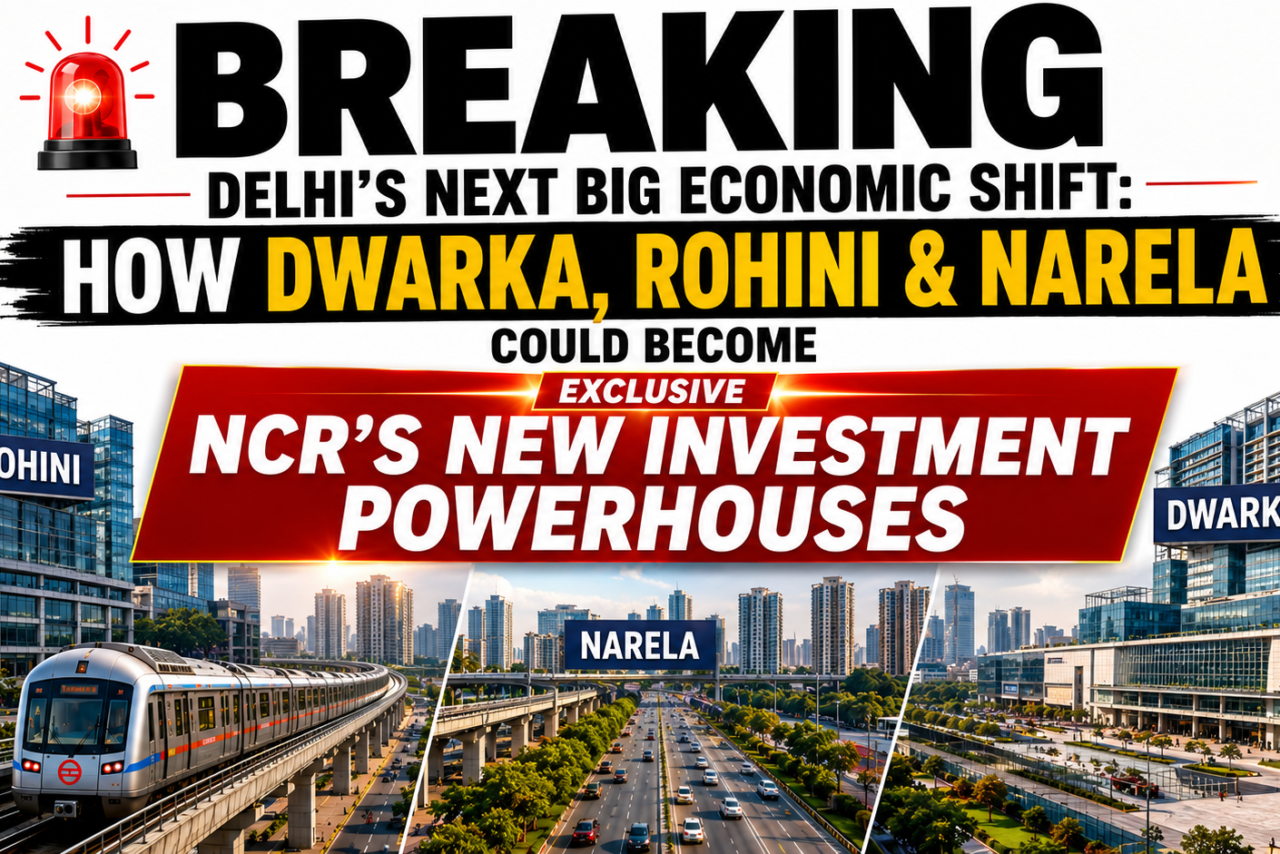

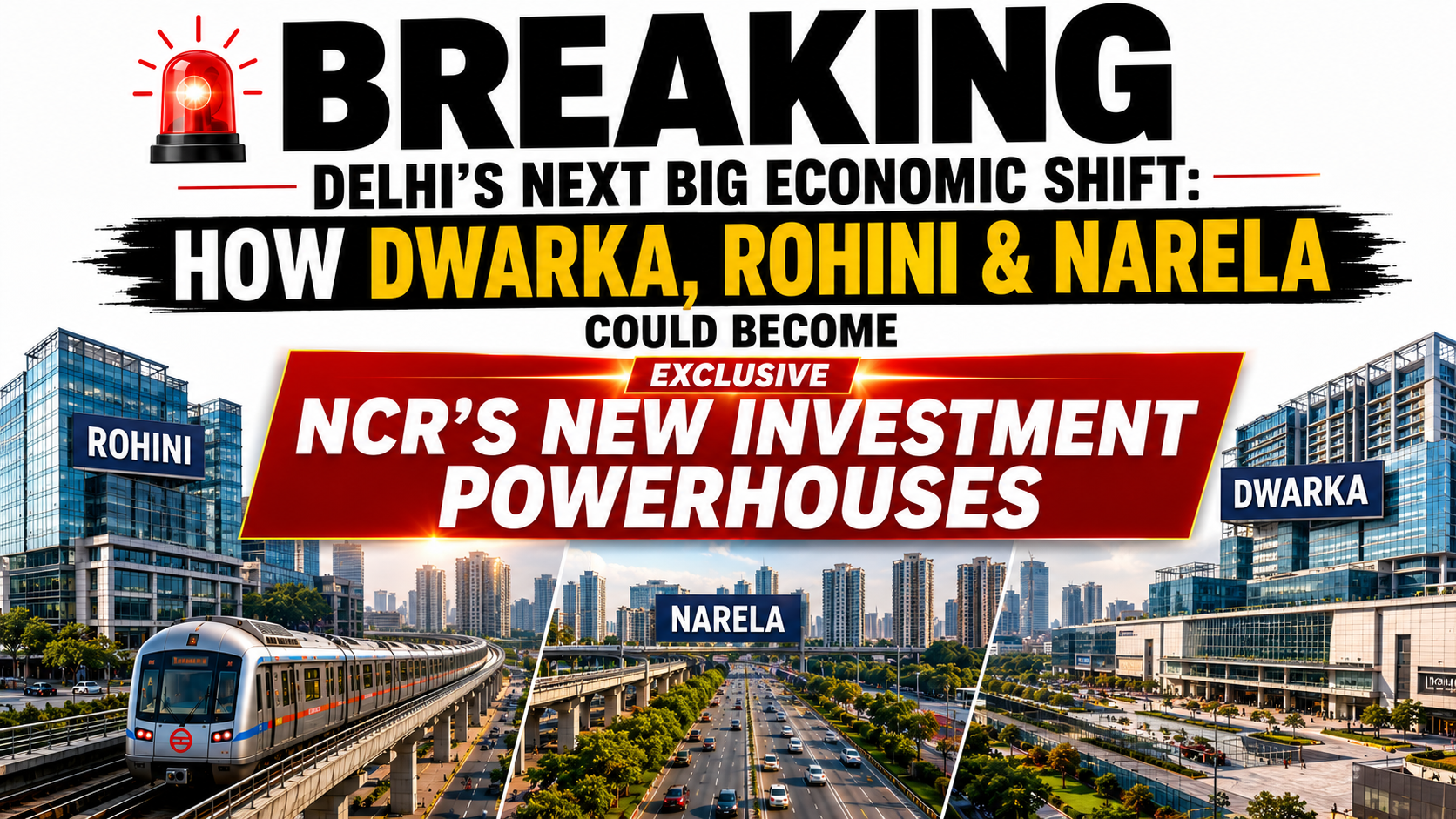
Dwarka Economic Hub could become one of Delhi-NCR’s biggest growth stories over the next decade as DDA explores major infrastructure expansion, data centres, semiconductor ecosystems and future-ready commercial development across Dwarka, Rohini and Narela.
For years, the growth story of Delhi-NCR revolved around Gurugram and Noida. Corporate offices, IT parks, startups, warehousing hubs and large-scale institutional investments steadily shifted towards these regions, while many parts of Delhi largely remained residential in character. However, that equation may now be beginning to change.
But now, a major transformation could be underway inside the national capital itself.
In a landmark strategic push, the Delhi Development Authority (DDA), under the leadership of Taranjit Singh Sandhu, is exploring plans to develop Dwarka, Rohini, Narela and other emerging sub-cities into decentralised economic hubs focused on future-ready industries.
This move has the potential to redefine Delhi’s urban economy over the next decade.
What Exactly Is Being Planned?
According to officials, the proposed Dwarka Economic Hub model is aimed at creating decentralised commercial and technology-driven growth corridors across Delhi’s emerging sub-cities.
The sectors under consideration include:
- Semiconductor ecosystem & chip design
- Data centres & digital infrastructure
- Global Capability Centres (GCCs)
- IT & IT-enabled services
- Warehousing & logistics
- Healthcare and research institutions
- Technology-driven commercial hubs
The objective is clear:
Instead of concentrating economic activity only in Central Delhi, Gurugram or Noida, the idea is to create multiple self-sustaining economic zones across Delhi’s peripheral urban districts.
This is not just urban expansion — it is economic decentralisation.
Why The Dwarka Economic Hub Could Transform Delhi
Among all the proposed regions, Dwarka stands out as the strongest contender for large-scale institutional and commercial transformation.
Several strategic advantages make Dwarka uniquely positioned:
1. Proximity to IGI Airport
Dwarka’s direct access to Indira Gandhi International Airport makes it highly attractive for:
- multinational corporations,
- technology firms,
- convention businesses,
- logistics operators,
- and global investment groups.
Experts believe the Dwarka Economic Hub could significantly benefit from its strategic proximity to the airport and upcoming international infrastructure projects.
2. Yashobhoomi Convention Centre Advantage
The presence of Yashobhoomi adds another massive advantage.
Large convention centres often become catalysts for:
- hotels,
- business tourism,
- exhibitions,
- global summits,
- startup events,
- and corporate networking ecosystems.
Over time, such infrastructure naturally attracts office spaces, institutional investments and hospitality growth.
3. Availability of Large DDA Land Parcels
One of the biggest challenges in Delhi has always been land availability.
Unlike saturated zones in Central Delhi, areas like Dwarka, Rohini and Narela still have planned urban land banks available under DDA control.
This allows: structured development, transit-oriented planning, institutional zoning and large-format infrastructure projects.
4. Massive Connectivity Push
The timing of this proposal is not accidental.
Over the last few years, Delhi’s outer zones have witnessed huge infrastructure upgrades:
- Urban Extension Road-II (UER-II)
- Dwarka Expressway connectivity impact
- Expanding Metro corridors
- Transit-Oriented Development (TOD) policy
- Improved regional connectivity with Haryana & NCR
These projects are rapidly reducing travel time between peripheral Delhi and major business districts.
What once felt “far” is now becoming central to future growth.
Improved metro networks, expressways and regional connectivity are expected to play a major role in accelerating the Dwarka Economic Hub vision over the coming years.
Semiconductor & Data Centre Push: Why It Matters
The push towards semiconductor and data-centre-related industries is particularly important because India is currently witnessing intense competition among states to attract future technology investments. States such as Gujarat, Tamil Nadu and Uttar Pradesh have already introduced aggressive policies to attract semiconductor companies by offering cheaper land, infrastructure support and faster approvals. Delhi has also started drafting its own semiconductor policy aimed at promoting chip design, research and advanced packaging, indicating that the capital wants to become part of India’s next technology growth cycle.
What makes this proposal particularly significant is that it goes far beyond real estate alone. If implemented effectively, it could create a completely new economic structure within Delhi. Employment generation, institutional investments, technology ecosystems and commercial expansion could gradually shift towards these emerging urban corridors. Instead of depending only on older commercial centres, Delhi could evolve into a more balanced, multi-nodal city with several self-sustaining business districts.
From a real estate perspective, such policy-level changes are often early indicators of long-term transformation. Historically, infrastructure development, government planning and institutional investments together have shaped the next major growth corridors in urban India. While these changes do not happen overnight, they often lay the foundation for future commercial demand, office development, hospitality growth and mixed-use urban ecosystems.
If implemented effectively, the Dwarka Economic Hub could emerge as one of North India’s most important technology and infrastructure-led growth corridors.
Bansal Housing Perspective
At Bansal Housing, we believe Delhi is entering the early stages of a new urban evolution.
For decades, NCR growth moved outward toward Gurugram and Noida. But now, Delhi’s own planned sub-cities are gradually positioning themselves for the next wave of economic activity.
The combination of policy direction, infrastructure upgrades, airport connectivity, institutional planning and future-ready industries
could make Dwarka and other emerging zones some of the most strategically important regions to watch over the next 5–10 years.
The story is no longer just about residential sectors. The story is about economic corridors, technology ecosystems and next-generation urban development. And Delhi may finally be preparing for that shift.



Leave a Reply