
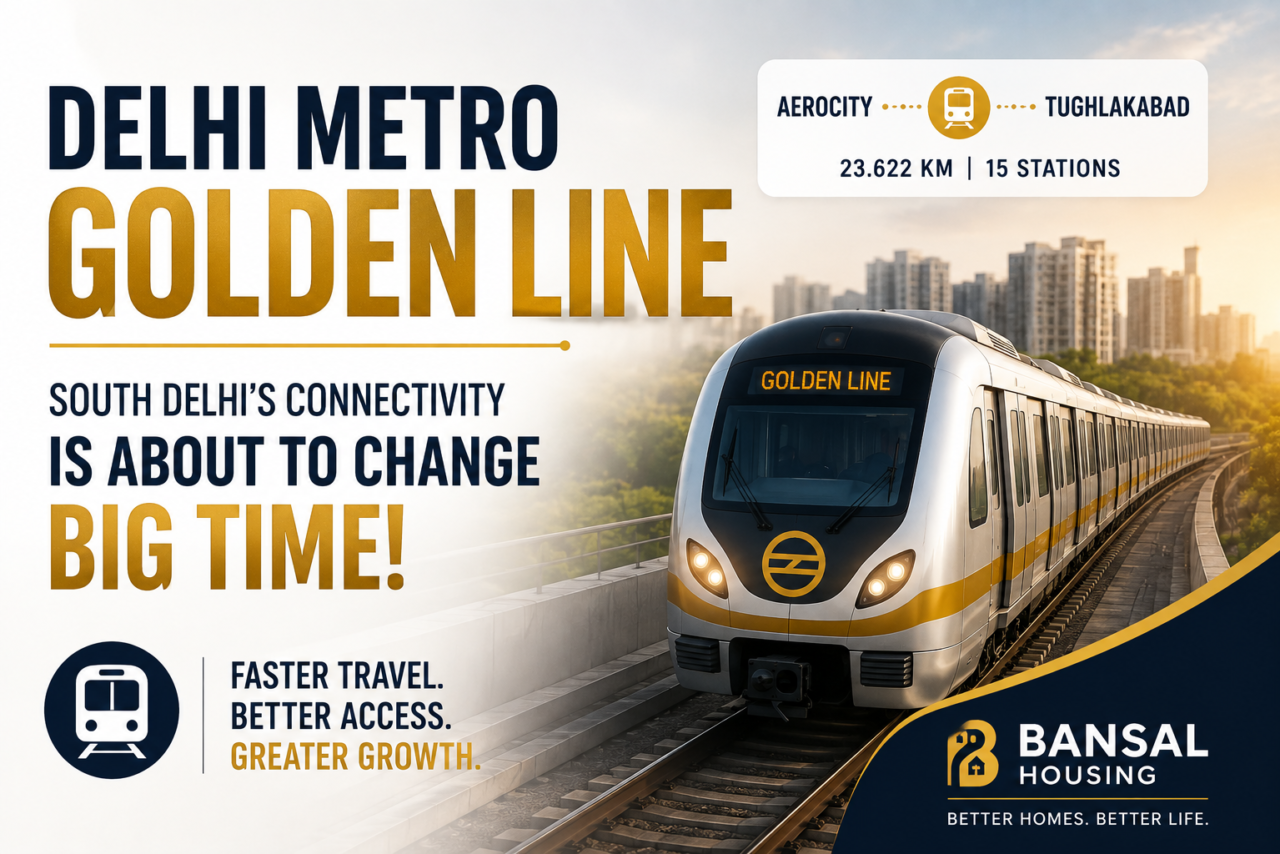

For years, South Delhi residents have dealt with traffic congestion, long travel times, and limited metro connectivity in several important residential areas. That is now set to change with the Delhi Metro Golden Line, one of the most significant infrastructure projects under Delhi Metro’s Phase 4 expansion.
Stretching over 23.6 km between Delhi Aerocity and Tughlakabad, the Delhi Metro Golden Line is expected to improve connectivity for thousands of daily commuters while creating new opportunities for homebuyers and real estate investors.
While the project is primarily designed to make travel easier, infrastructure upgrades like this have historically played an important role in shaping property markets. From improved accessibility to increasing demand for residential and commercial spaces, metro corridors often become long-term growth catalysts.
What Is the Delhi Metro Golden Line?
The Delhi Metro Golden Line (Line 10) is a new metro corridor being developed as part of Delhi Metro Phase 4.
Key Highlights
- Total Corridor Length: 23.622 km
- Total Stations: 15
- 11 Underground Stations
- 4 Elevated Stations
- Proposed Initial Opening: Neb Sarai to Delhi Aerocity
- Full Corridor Target: March 2026
- Extension Approved to IGI Airport Terminal 1
The corridor will connect several important residential and commercial locations including:
- Delhi Aerocity
- Mahipalpur
- Vasant Kunj
- Kishangarh
- Chhatarpur
- Chhatarpur Mandir
- IGNOU
- Neb Sarai
- Saket G Block
- Ambedkar Nagar
- Khanpur
- Sangam Vihar
- Tughlakabad
Once operational, the corridor will offer faster connectivity between South Delhi, IGI Airport, Gurgaon, and several key employment hubs.
Why the Delhi Metro Golden Line Matters for Delhi NCR
Infrastructure projects are often more than transportation upgrades—they influence how cities grow.
The Delhi Metro Golden Line is expected to:
- Reduce travel time across South Delhi
- Improve airport connectivity
- Ease traffic congestion
- Increase accessibility to residential neighbourhoods
- Support commercial development
- Enhance overall quality of life
Areas that previously had limited public transport access, such as Neb Sarai, Khanpur, and Sangam Vihar, are expected to benefit significantly from improved connectivity.
Engineering Progress Signals the Project Is Moving Ahead
Construction on the Delhi Metro Golden Line has reached an advanced stage.
Recent developments include:
- Successful completion of a 1.55 km underground tunnel between Kishangarh and Vasant Kunj.
- Multiple Tunnel Boring Machines (TBMs) actively working on different sections.
- Station finishing work progressing across several locations.
- Signage tenders issued for underground stations.
- Overall project completion crossing 70%.
These milestones indicate that the project is steadily moving toward phased operational launches.
How the Delhi Metro Golden Line Could Impact Real Estate
Infrastructure and real estate have always shared a strong relationship.
Whenever a new metro corridor becomes operational, nearby locations often experience increased buyer interest because better connectivity improves convenience, reduces commuting time, and enhances the overall appeal of a neighbourhood.
The Delhi Metro Golden Line is expected to create positive momentum across several South Delhi micro-markets.
Potential benefits include:
- Higher residential demand
- Improved rental yields
- Better commercial footfall
- Increased investor confidence
- Greater long-term property appreciation potential
For homebuyers, metro connectivity often becomes an important deciding factor when choosing a property.
Localities That Could Benefit from the Delhi Metro Golden Line
Several established and emerging locations are expected to benefit from the new corridor.
Vasant Kunj
Already one of South Delhi’s premium residential destinations, improved metro connectivity may further strengthen its appeal among professionals and families.
Chhatarpur
As an important interchange station, Chhatarpur could witness increased residential and commercial activity over the coming years.
Saket
Known for its malls, healthcare facilities, educational institutions, and corporate offices, Saket is expected to benefit from enhanced metro accessibility.
Neb Sarai
Affordable housing options combined with improved connectivity could make Neb Sarai increasingly attractive for first-time homebuyers.
Sangam Vihar
One of Delhi’s densely populated residential areas may see better accessibility and improved daily commuting through the Golden Line.
What Does This Mean for Property Buyers?
For end-users, the Delhi Metro Golden Line offers more than faster travel.
It can mean:
- Easier office commutes
- Better airport access
- Improved connectivity to educational institutions
- Enhanced access to healthcare and shopping destinations
- Better overall convenience for daily life
Improved transportation often increases the attractiveness of residential neighbourhoods over the long term.
Why Investors Are Watching the Delhi Metro Golden Line
Real estate investors closely monitor infrastructure developments because connectivity is one of the strongest drivers of property demand.
The Delhi Metro Golden Line has the potential to support:
- Higher rental demand
- Better occupancy rates
- Commercial growth around metro stations
- Increased buyer enquiries
- Long-term capital appreciation
While infrastructure alone does not guarantee investment returns, it often becomes one of the key indicators of future market growth.
Investment Perspective with Bansal Housing
At Bansal Housing, we believe successful real estate investing begins with understanding where future infrastructure is creating new opportunities.
Projects like the Delhi Metro Golden Line, Dwarka Expressway, Noida International Airport, and other major connectivity initiatives are gradually reshaping the Delhi NCR property market.
Whether you are looking for your first home, upgrading your residence, or exploring investment opportunities, evaluating infrastructure development alongside builder reputation, location, legal approvals, and long-term growth potential can help you make more informed decisions.
Our team closely tracks major policy announcements and infrastructure developments to help buyers identify locations with strong long-term potential across Delhi NCR.
Conclusion
The Delhi Metro Golden Line represents much more than another metro corridor. It is an important infrastructure project that has the potential to improve connectivity, enhance accessibility, and support long-term real estate growth across South Delhi.
As construction progresses and phased operations begin, homebuyers and investors will continue to monitor how this corridor influences property demand and development patterns.
For anyone planning to invest in Delhi NCR real estate, infrastructure projects like the Delhi Metro Golden Line remain one of the most important factors to consider when evaluating future growth opportunities.
Frequently Asked Questions
What is the Delhi Metro Golden Line?
The Delhi Metro Golden Line is a 23.6 km metro corridor under Delhi Metro Phase 4 connecting Delhi Aerocity to Tughlakabad through 15 stations.
Which areas will benefit from the Delhi Metro Golden Line?
Areas including Vasant Kunj, Chhatarpur, Saket, Neb Sarai, Khanpur, Mahipalpur, and Sangam Vihar are expected to benefit from improved connectivity.
How can the Delhi Metro Golden Line impact property prices?
Improved metro connectivity often increases residential demand, rental activity, and long-term investment interest in nearby locations.
Is the Delhi Metro Golden Line good for real estate investment?
Infrastructure projects like the Delhi Metro Golden Line can positively influence property markets over time. However, buyers should always evaluate location, builder credibility, legal approvals, and market conditions before making any investment decision.


Leave a Reply